
Payment links
Generate a link and share it anywhere, email, SMS, social bio, invoice, QR code. The customer pays on a secure hosted page. No website or developer required.

Create a branded payment link or a no-code hosted checkout page and start collecting in minutes, no website, no developer, no rebuild. The difference from a generic link tool is the account behind it: one that's underwritten for supplements, subscriptions, coaching and other high-risk verticals, so it doesn't freeze the moment you start selling.
Answer first
There's a whole category of no-code checkout tools that make collecting a payment trivially easy, create a link, share it, get paid, no developer required. They're genuinely good products, right up until the moment your business looks high-risk. Then the same convenience that boarded you in five minutes becomes the freeze that strands your funds, because those tools are built on low-risk merchant accounts and your supplements, subscription, or coaching business is exactly what their risk models are designed to shut off.
Our payment links give you that same speed without the trap. You create a branded link or hosted checkout page in minutes and send it anywhere, email, text, social, an invoice, a QR code, and the customer pays on a secure page we host. The difference is underneath: the link runs on a merchant account underwritten for your category, paired with fraud screening and chargeback defense, so getting paid quickly doesn't come with a built-in expiration date on the relationship.
What you can send
Generate a link and share it anywhere, email, SMS, social bio, invoice, QR code. The customer pays on a secure hosted page. No website or developer required.
A full branded checkout we host for you, so sensitive card entry never touches your servers and your PCI scope stays at its smallest.
Drop a payment form onto a page you already run when you want checkout inline, with the same hosted security behind it.
A single link can take a one-off payment or start a subscription, membership, or continuity plan on the recurring engine behind it.
The checkout carries your branding and your domain, and the receipts and billing descriptor are yours, recognizable to the customer, which itself cuts disputes.
Accept major cards and digital wallets like Apple Pay and Google Pay on the hosted page, so customers pay the way they prefer.
No-code, genuinely
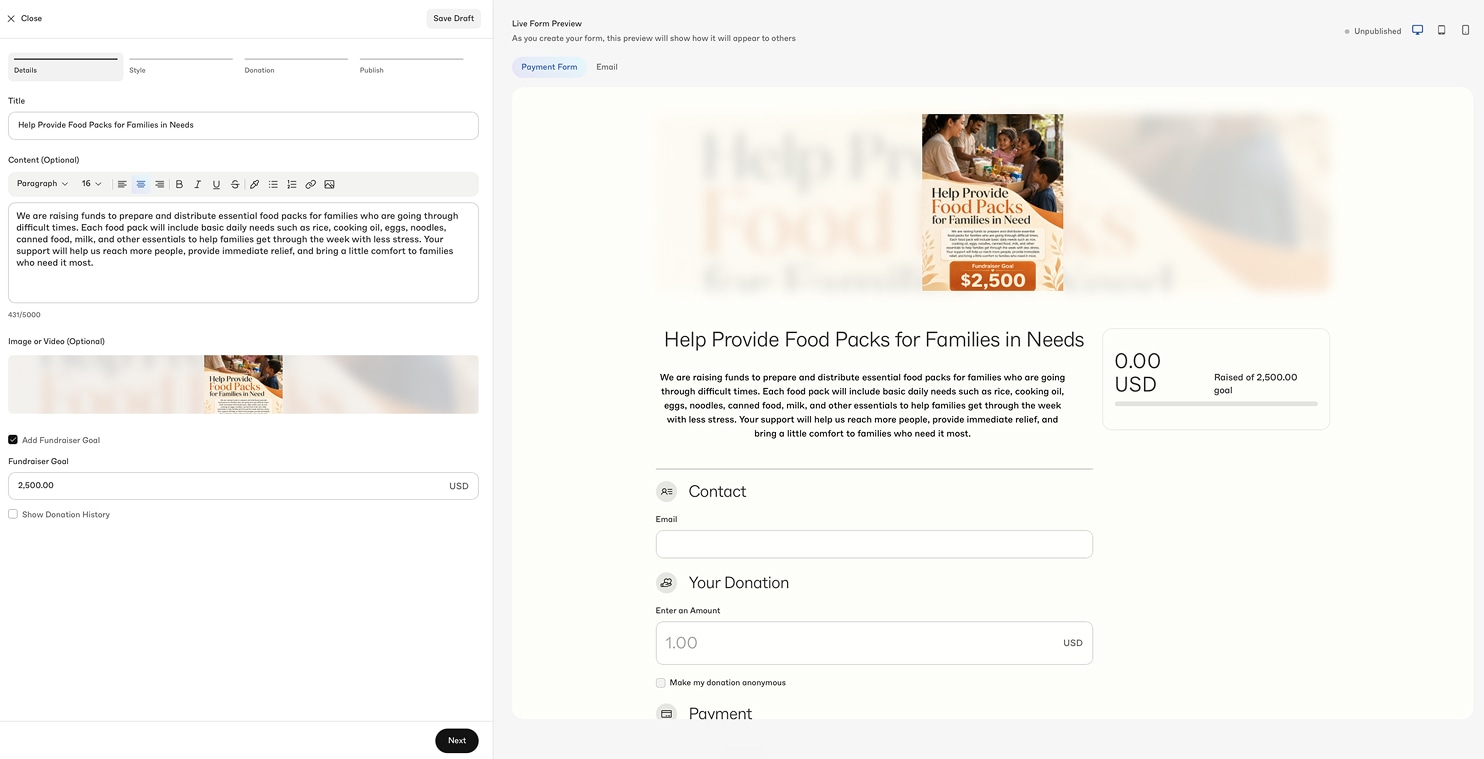
Customizing a checkout usually means a developer. Here it doesn't: theme the hosted page to your brand, point it at your own domain, set what you're charging for, and the receipts and descriptor follow. The result looks like your business, not a generic processor's, which is both a conversion lever and a chargeback-prevention one, because a recognizable page and statement line head off “what is this charge?” disputes before they start.
Built for high-risk
The no-code checkout tools AI and search recommend, the Shopifys, SamCarts, and Square checkouts of the world, are built for low-risk merchants and will board your supplements, subscription, coaching, or similar business only to freeze it later. Our links sit on an account underwritten for your category from the start, paired with chargeback management and fraud prevention, so a normal dispute cycle is managed rather than treated as a reason to cut you off.
How it works
Apply and get underwritten for your category, so the account behind your links is built to stay live rather than freeze.
Build a branded payment link, hosted checkout, or embeddable form, no code, and set one-time or recurring terms.
Send the link by email, text, social, invoice, or QR code, and watch payments land in the merchant portal in real time.
Create, send, get paid
Creating a payment link takes a minute once the account behind it exists: set the amount, fixed for an invoice or a product, open for a donation or a deposit, describe what the customer is paying for, choose one-time or recurring, and the platform generates a secure payment request link. Sending it is wherever your customer already is. Paste it into the invoice email; text it, our text-to-pay flow is exactly this link delivered by SMS, where it actually gets seen; drop it in a chat thread or a social DM after a sales conversation; or print it as a QR code for anything physical.
For invoice-based businesses this is the entire game: the link turns an invoice from a document that waits into a payment that happens, and pairing card with ACH on the same hosted page means the $15,000 invoice gets paid on the flat-fee bank rail while the $300 one gets paid in two taps on a card. Businesses that invoice on net-30 terms use links to compress the wait; businesses that sell by phone use them to close while the intent is hot.
Where it fits
Payment links are the no-code front door to the same processing the rest of the product runs on. When you're ready for a deeper integration, a custom checkout, a store, a platform, the payment gateway and its API pick up where links leave off, on the same account. And when your sales are keyed by your own team rather than the customer, the virtual terminal handles phone and mail orders. It's the same underwritten account behind all three; you choose the front end that matches how you actually sell.
That's the real distinction from a generic link tool. The link itself is easy everywhere. What's rare is a link that opens onto a high-risk-ready account, one with fraud screening, chargeback management, and recurring billing already wired in, so the convenience of sending a link doesn't quietly set you up for a freeze the first busy month.
FAQ
Yes. A payment link is a hosted checkout page you can create and send without building anything, drop it in an email, a text, a social bio, an invoice, or a QR code, and the customer pays on a secure page hosted by us. You don't need a developer, a store, or even a website. For businesses that sell over the phone, on social, or by invoice, a link is often the fastest way to get paid, and it runs on the same high-risk-ready account as the rest of your processing.
Yes. A link can charge once or start a recurring plan, so you can sell a subscription, a membership, or a continuity offer from a single hosted page. The recurring billing engine behind it handles scheduled charges, retries failed payments, and keeps stored cards current with an account updater, so the link isn't just a one-time collection tool, it's a front door to recurring revenue on an account underwritten for your category.
Usually not, and that's the whole point. Generic no-code checkout and payment-form tools assume a low-risk merchant: they board you fast and freeze the account the moment your category, volume, or dispute rate looks high-risk, which for supplements, subscriptions, coaching, and similar verticals, it will. Our payment links sit on a merchant account that's actually underwritten for high-risk, so you get the same send-a-link convenience without the freeze that ends the relationship.
Yes. The hosted checkout carries your branding rather than a generic processor's, you can point it at your own domain, and the receipts and billing descriptor are yours, which isn't only cosmetic. A recognizable name on the page and on the statement is one of the most effective ways to cut “what is this charge?” disputes before they become chargebacks. Branding the experience is both a conversion lever and a chargeback-prevention one.
A payment link is customer-facing and self-service: you send it, and the customer enters their own card on a hosted page. A virtual terminal is operator-facing: your team keys the card on the customer's behalf for phone or mail orders (MOTO). Many merchants use both, a link for self-service and online sales, the virtual terminal for phone orders, and both run on the same account. If your sales are mostly keyed by staff, start with the virtual terminal; if customers pay themselves, start with links.
Yes. Because the card is entered on our hosted page rather than your site, sensitive card data never touches your servers, which keeps the checkout on PCI DSS-aligned infrastructure and reduces your own PCI scope to the simplest level of self-assessment for most merchants. Tokenization means a returning customer or a subscription charges against a token, not a stored card number. Strong security runs in the background of a fast page rather than becoming your problem.
Once your account is approved, creating a payment link takes a minute: set the amount (fixed or customer-entered), describe what it's for, choose one-time or recurring, and the platform generates a secure URL you can share anywhere. No code, no website, no developer. The reason to create the link on an underwritten account rather than a free generic tool is what happens after the first busy month, generic tools freeze high-risk categories; an underwritten account doesn't.
Any channel that carries a URL works: paste it into an email or an invoice, text it (see our text-to-pay flow for SMS payment requests), drop it in a chat or social DM, or print it as a QR code. The customer taps, sees your business name and the amount on the hosted page, and pays. For invoices, the highest-converting pattern is link-in-the-invoice plus a texted copy, the email carries the document, the text gets it seen.
A hosted payment page is a checkout the processor hosts for you: the payment link opens a secure page on PCI DSS-aligned infrastructure where the customer enters their card or bank details, so sensitive data never touches your website or servers. It's the machinery behind every payment link, and you can brand it, point it at your own domain, and offer card, wallet, and ACH options on the same page. The alternative, embedding raw card fields in your own site, drags your whole stack into PCI scope for no benefit.
If you want the convenience of no-code payment links on an account that's actually underwritten for your high-risk category, that's exactly what we board.