Split payouts, done correctly
One buyer charge divided across the sellers involved and your commission, at transaction time or on a settlement schedule you define.

GivePayments powers marketplace payments, collecting a single payment from a buyer and splitting payouts across multiple sellers, with sub-merchant onboarding, KYC, and payouts handled underneath. Our high-risk underwriting depth means we can board seller categories that mainstream marketplace infrastructure declines.
Answer first
A marketplace has a payments problem single-merchant businesses never face: the buyer pays once, but the money belongs to several parties. A buyer checks out, and the funds have to reach the right seller, minus your commission, with everyone's taxes, payouts, and compliance handled correctly. Multiply that across thousands of sellers and the payments layer stops being a checkout and becomes infrastructure, you're effectively running onboarding, KYC, settlement, and compliance for a population of sub-merchants, not processing for one business.
We provide the rails that take a single buyer transaction, split it across sellers and your platform fee, and settle each leg cleanly, with the seller onboarding, verification, and regulatory plumbing built in rather than bolted on. And because we underwrite high-risk verticals natively, a marketplace whose sellers operate in harder categories isn't shut out the way it would be on mainstream marketplace infrastructure.
What the platform handles
One buyer charge divided across the sellers involved and your commission, at transaction time or on a settlement schedule you define.
Partial refunds across a split order, payouts to sellers in different states, and holds on a seller under review, handled in the rails.
Identity and business verification, bank-account validation, and sanctions screening, embedded inside your own product flow.
Reporting that keeps your books and your sellers' books straight, with every payout traced back to its originating transaction.
Low-risk service providers get a lighter touch; elevated-risk goods get deeper screening, tuned to your categories, not one blunt setting.
Underwriting built for high-risk from the start means we can sponsor and board sub-merchants mainstream infrastructure turns away.
Registration and sponsor concurrence
How it works
A split payment divides one buyer charge across multiple recipients, the sellers involved and your platform's commission, either at transaction time or on a settlement schedule you define. The mechanics sound simple and the edge cases are where it gets real: partial refunds across a split order, payouts to sellers in different states, holds on a seller under review, and reconciliation that has to tie every payout back to its originating transaction. We handle the split logic, the payout execution, the reporting, and the compliance on each leg.
Every seller on your marketplace is a sub-merchant, which means every seller needs onboarding and KYC, identity and business verification, bank-account validation for payouts, and screening calibrated to the risk of what they sell. On our infrastructure that flow embeds into your own product: sellers sign up inside your platform's experience while the verification, sanctions screening, and risk checks run underneath. And because our underwriting was built for high-risk from the start, a marketplace serving genuinely difficult categories doesn't have to choose between rejecting those sellers and duct-taping a workaround.
Per-seller visibility
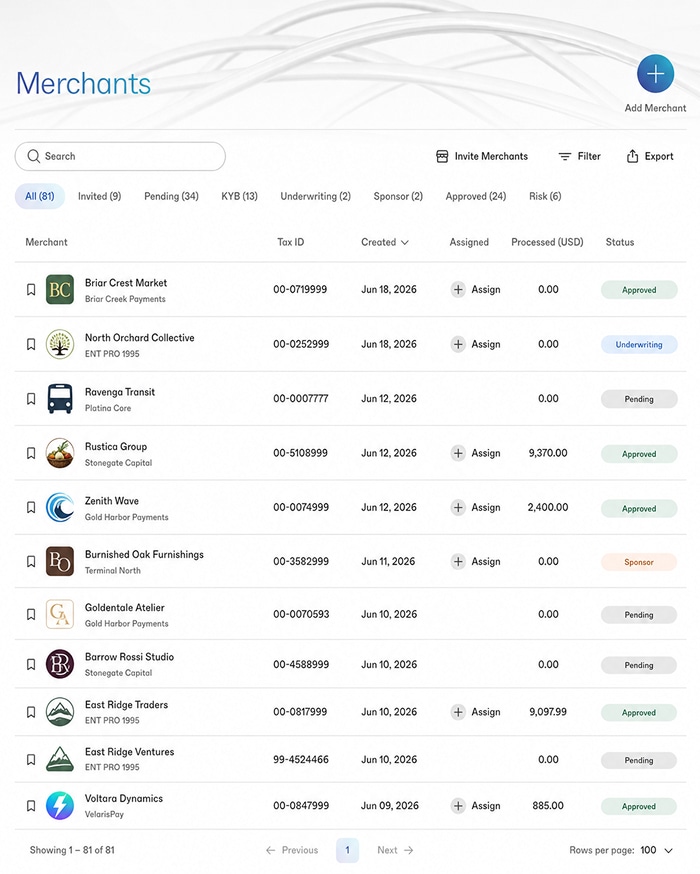
Each seller is boarded as a sub-merchant with its own overview, volume, balance, payout status and risk standing, so you and your sellers can both see exactly where a payout stands.
How it works
Your seller mix, volume, geography and how payouts should flow, so we can map the structure to your marketplace.
We tell you whether you fit PayFac-as-a-Service on our sponsorship or need full payment-facilitator registration, before you architect.
Sub-merchant onboarding, KYC and screening embed into your own flow, with depth calibrated to your categories.
We take each buyer transaction, split it across sellers and your fee, and settle every leg with reconciliation built in.
FAQ
Marketplace payments are the infrastructure that lets a platform collect a single payment from a buyer and route the funds to multiple sellers, while taking its own fee. It's what powers any multi-vendor marketplace, the buyer pays once, the platform settles to the right sellers, and everyone's KYC, payouts, and compliance are handled underneath. It's more complex than single-merchant processing because you're effectively boarding and managing many sub-merchants, not one.
A split payment takes one buyer transaction and divides the funds across multiple recipients, typically the sellers involved plus the platform's commission. The split can happen at the time of the transaction or on a settlement schedule, and each seller is a sub-merchant with their own onboarding and KYC. The platform defines the split logic; the payments infrastructure executes it and handles the payouts, reporting, and compliance for each leg.
It depends on the model and volume. Collecting funds on behalf of sellers and splitting payouts implicates payment-facilitator and money-transmission rules, and above certain thresholds the card networks require registration. Many marketplaces get the capability they need through a PayFac-as-a-Service model on our sponsorship without registering themselves, while larger marketplaces register as full payment facilitators. We assess your model and tell you which path applies before you build.
Each seller is a sub-merchant who goes through onboarding and KYC, identity and business verification, bank-account validation for payouts, and screening appropriate to the risk of what they sell. On our infrastructure that onboarding can be embedded into your platform's own flow, so sellers sign up inside your product while the verification and compliance run underneath. The depth of verification scales with the risk profile of your marketplace's categories.
Yes, and it's where most marketplace-payments providers stop. If your sellers operate in elevated-risk categories, mainstream marketplace infrastructure tends to decline the whole platform. Our high-risk underwriting depth means we can sponsor and board sub-merchants that other providers won't, so a marketplace serving harder verticals isn't forced to choose between turning sellers away and stitching together a workaround. We underwrite the model before boarding.
Marketplace payments aren't a sign-up flow. Walk us through how your platform works and we'll map the model, flag the registration path early, and tell you straight whether your seller categories are boardable.