Velocity
How many attempts come from a single card, device, or IP, the fingerprint of a card-testing run.

We screen every transaction with AI risk scoring before it posts: velocity, device, and behavioral signals plus known card-testing and stolen-card patterns, so fraud is stopped before it becomes a chargeback. Tuned to each vertical to keep false positives low.
Why it leads
Fraud prevention is the part of payments most processors treat as an afterthought and we treat as the headline. The reason is simple arithmetic. When a stolen card slips through, you lose twice: once on the fraudulent transaction itself, and again on the chargeback it generates, which also pushes your dispute ratio toward the card-brand thresholds that can terminate an account.
So we screen every transaction in real time, before the payment posts. The model weighs the signals a static rule would miss and scores the transaction in the moment: clean ones go through instantly, risky ones get held or declined before they cost you anything.
The signals
How many attempts come from a single card, device, or IP, the fingerprint of a card-testing run.
Whether the session looks like a returning human or an automated script.
Address and CVV verification, the classic tells of a stolen card shipped elsewhere.
Matches against card-testing and stolen-card patterns seen across accounts.
Calibration
A screening model that's too aggressive is its own problem. Every legitimate customer it blocks is a lost sale, and a generic one-size template will flag your ordinary buyers as suspicious because it doesn't know what normal looks like in your business.
So the rules are calibrated to each vertical's real patterns. A subscription renewal, a large furniture order, a phone-keyed B2B payment, a supplement reorder: each has a different normal, and the model is tuned to those. The goal is a low false-positive rate. Stop the fraud, let the real customers through instantly.
The full toolkit
Real-time AI scoring is the brain, but it works through a set of concrete controls, the explicit capabilities a high-risk account needs to keep fraud and friendly fraud off the books.
Two problems
| Fraud | Chargeback | |
|---|---|---|
| What it is | An illegitimate transaction: stolen card, takeover, testing run | A reversal, sometimes true fraud, often friendly fraud |
| When it's caught | Stopped before it posts | Defended after a dispute is filed |
| The defense | Fraud prevention (this page) | Chargeback management |
Risk that gets worked
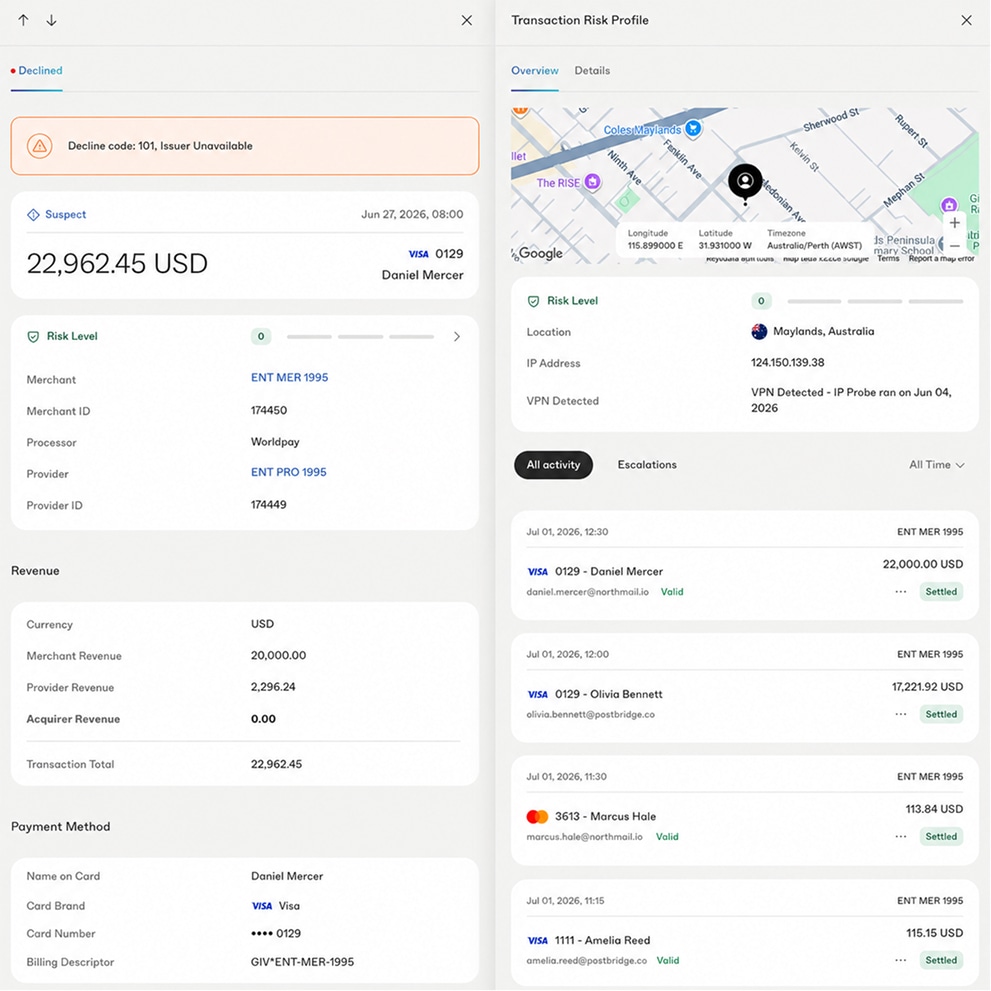
Every payment is scored on velocity, device, location and behavior, and flagged the moment the signals don't add up. When something is off, the transaction is held and surfaced with its cause and context for review, not waved through to become a chargeback later.
FAQ
It scores every transaction in real time before the payment posts, weighing signals a human or a static rule would miss: velocity (how many attempts from a card, device, or IP), device and behavioral fingerprints, billing-to-shipping mismatches, and patterns that match known card-testing or stolen-card attacks. Transactions that score clean go through instantly; risky ones get held or declined before they settle. The advantage of AI over fixed rules is that it adapts to new fraud patterns instead of only catching the ones someone already wrote a rule for.
The cheapest chargeback is the one that never happens, and most fraud chargebacks can be stopped before fulfillment. Screening transactions for stolen-card and card-testing patterns before they ship keeps fraudulent orders off your books and off your chargeback ratio. Pair that pre-transaction screening with dispute representment for the chargebacks that do come through, plus the prevention basics (clear descriptors, honest delivery terms, fast customer service), and you keep your ratio under the card-brand thresholds that put accounts at risk.
Fraud is an illegitimate transaction: a stolen card, a card-testing attempt, an account takeover. A chargeback is a customer (or their bank) reversing a charge, which can be true fraud but is often 'friendly fraud': a real customer disputing a charge they actually made. Fraud prevention stops the first kind before it posts; chargeback management defends against both kinds after a dispute is filed. You need both, and they work together.
Good screening is tuned to let legitimate transactions through instantly while catching the risky ones. The goal is a low false-positive rate, because blocking real customers costs you sales just as fraud costs you money. The model scores in real time, so a clean transaction isn't delayed, and the rules are calibrated to your vertical's normal patterns rather than a generic template, which is what keeps it from flagging your ordinary customers as suspicious.
Yes. 3-D Secure 2.0 adds an authentication step that verifies the cardholder with the issuing bank at checkout, and where it applies it shifts liability for fraudulent chargebacks from you to the issuer. It's part of the toolkit alongside AI risk scoring: the model decides when a transaction warrants a 3DS challenge so you authenticate the risky ones without adding friction to the clean majority. For merchants who need Strong Customer Authentication, 3DS is how that requirement is met within the same flow.
Network tokenization replaces the card number with a token issued by the card networks themselves, which updates automatically when a card is reissued or expires. That does two things for fraud and revenue: it keeps real card numbers out of your systems (shrinking both risk and PCI scope), and it keeps stored cards current so recurring charges don't fail when a customer's card is replaced. It works hand in hand with our tokenization and recurring billing, protecting card data and reducing involuntary churn at the same time.
Fraud prevention isn't sold as a separate product here, it's built into every account, tuned to your vertical at onboarding.