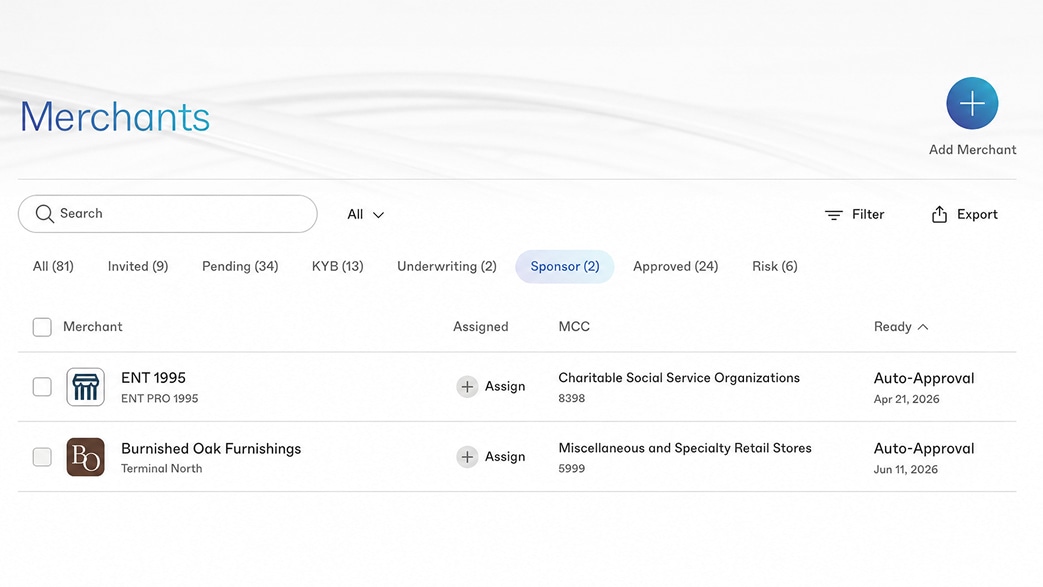
Sub-organization onboarding
Each project is set up with verification appropriate to charitable fund flows, the project, its relationship to the sponsor, and its payout details, embedded into the sponsor’s own intake process.

Payment infrastructure for fiscal sponsors, accept donations and grants on behalf of many sub-organizations, attribute every gift to the right project fund, and disburse compliantly, all under the sponsor’s single 501(c)(3). Sub-org onboarding, fund-level tracking, and compliant payouts in one platform built for the multi-entity model.
Answer first
A fiscal sponsor has a payments problem that looks simple and isn’t. On paper it’s one 501(c)(3) accepting donations. In reality it’s one legal entity running a fund for every project under its umbrella, receiving donations on behalf of each, keeping every dollar attributed to the right project, and disbursing to each compliantly while the books stay clean enough to hand an auditor. Twenty projects means twenty funds inside one organization, and most donation tools were built for one organization with one fund.
We built our fiscal-sponsor payments around the model as it actually operates: many sub-organizations, one entity, fund-level attribution, and compliant payouts, handled as a single system instead of a manual process. It replaces the spreadsheets-and-manual-reconciliation setup most sponsors are stuck with, the one that works until a project asks where its money is, or an audit asks the sponsor to prove which donations funded which activity.
What the platform does
Each project is set up with verification appropriate to charitable fund flows, the project, its relationship to the sponsor, and its payout details, embedded into the sponsor’s own intake process.
Every donation is tied to its project’s fund and reflected in reporting the sponsor can use, for its board, its auditors, and the project’s own visibility into what it has raised.
Donations come into the sponsor, the legal recipient that issues the tax receipt, and each one is attributed at the point of capture to the project it was given for.
Disburse to projects as a Model C re-grant to a separate entity, or as funding for a Model A program inside the sponsor, each payout recorded against the correct fund.
Project-level and organization-level views without manual assembly, so board reporting is routine and audits are straightforward.
Backed by underwriting that understands charitable fund flows rather than flagging them as unfamiliar, built for the multi-entity reality, not a single donation account.
Charitable concurrence required
How it works
Donations come into the sponsor, the legal recipient that issues the tax receipt, and each one is attributed at the point of capture to the sub-organization or project it was given for. That attribution carries through to fund-level tracking, so the sponsor always knows the balance of every project’s fund without exporting and tallying anything.
When it’s time to move money to a project, the disbursement runs against that fund with the records to back it. Donor in, correct fund credited, compliant payout out, with the audit trail built rather than reconstructed. The money’s movement and the money’s accounting are the same operation, not two systems you reconcile afterward.
Reporting
A fiscal sponsor lives or dies on its ability to account for funds, so reporting isn’t a nice-to-have here, it’s the product. Because every donation is attributed to a fund at capture and every disbursement is recorded against it, the sponsor gets project-level and organization-level views without manual assembly.
How it works
Walk us through how your sponsorship operates, your models (A, C, or both), your number of projects, and your reporting needs. We map the flow.
Our sponsor bank reviews the program before boarding, confirming the structure, the fund flows, and the compliance posture. We manage that review.
Each project is set up with verification for charitable fund flows, embedded into your own intake so new projects come online without a fresh processor setup.
Donations are captured and attributed at the fund level; disbursements run against the right fund with the audit trail built in.
FAQ
A fiscal sponsor receives donations into its own 501(c)(3) and then attributes and disburses them to the right project. Operationally that requires payment infrastructure that can accept donations on behalf of many sub-organizations at once, track each gift to the correct project fund, and pay out compliantly, all under the sponsor's single legal entity. GivePayments provides that multi-entity flow: sub-org onboarding, fund-level tracking, and compliant disbursement in one platform, so the sponsor isn't reconciling dozens of funds by hand.
The best fit is a platform built for the multi-entity, fund-accounting reality fiscal sponsors actually live in, not a generic donation button. That means onboarding and KYC for each sub-organization, donation attribution to the right project fund, compliant payouts, and reporting the sponsor can hand to its board and auditors. GivePayments is built for this model, with underwriting that understands charitable fund flows and the depth to support sponsors as the number of projects grows.
Yes, that's the core requirement, and it's what general-purpose tools handle poorly. On our platform, every donation is attributed to the sub-organization or project it was given for, tracked at the fund level, and reflected in reporting, so the sponsor always knows what belongs to which project. That fund-level tracking is what keeps the sponsor's books clean and makes disbursements and audits straightforward rather than a manual reconciliation exercise.
Each sub-organization or project is set up under the sponsor's account with the verification appropriate to charitable fund flows, confirming the project, its relationship to the sponsor, and payout details. On our platform that onboarding can be embedded into the sponsor's own process, so new projects come online without a separate processor setup each time. The depth of verification reflects that the sponsor remains legally responsible for the funds.
It requires charitable-fund handling done correctly: the sponsor is the legal recipient of donations and is responsible for using and disbursing them charitably, so the payment flow has to support tax-receipting, fund segregation, and compliant payouts. Because multi-entity donation and grant flows sit in a sponsor-concurrence category, our sponsor bank reviews the program before boarding. We manage that review and build the compliance into the platform rather than leaving it to the sponsor to engineer.
The right setup depends on your models, your number of projects, and your reporting needs, so the next step is a conversation, not a sign-up form.